
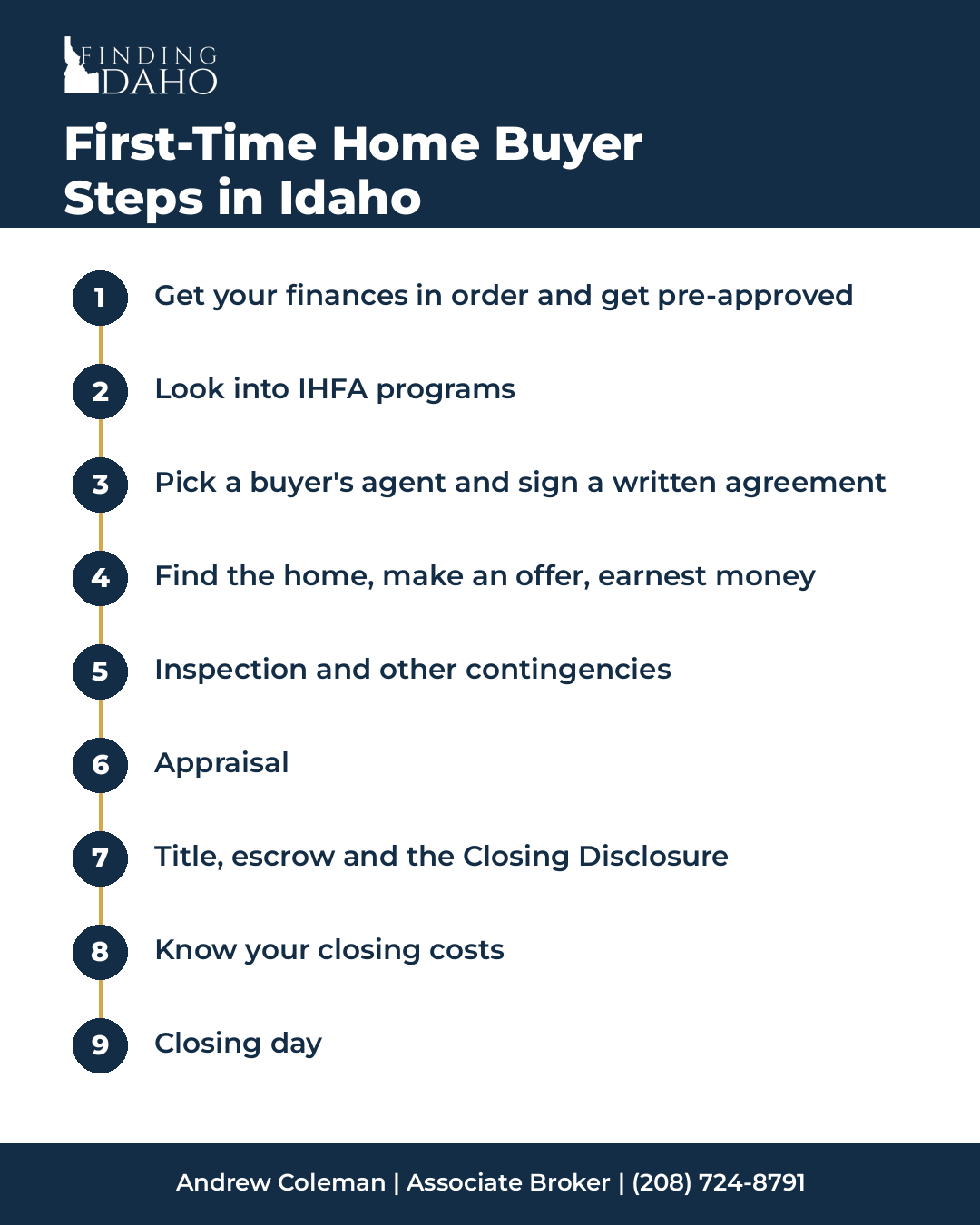
First-Time Home Buyer Steps in Idaho
Buying your first home can feel like a mystery, but it's really a series of steps that happen in a certain order. Most of the stress comes from not knowing what's next. So here's the order, with the Idaho-specific parts called out. If you only take one thing from this: get a lender and a buyer's agent lined up early. It makes everything after that easier.
Step 1: Get your finances in order and get pre-approved
Start with a lender. According to Idaho Housing and Finance Association (IHFA), a lender will walk you through pre-approval, and your pre-approval letter will outline your affordable price range. IHFA suggests having these ready:
- Income documents (pay stubs, W-2s, tax returns)
- Bank and asset statements
- Identification
IHFA points out two things I'd underline. First, it's common to be pre-approved for more than you actually want to pay, so pick a payment you're comfortable with. Second, IHFA says a credit score of 620 or higher "is beneficial." That's their wording, not a hard minimum for every loan, so ask your lender what applies to you.
One more thing: pre-approval isn't a guarantee. Final underwriting happens after your offer is accepted, when the lender verifies your income, assets, debt and credit.
Step 2: Look into IHFA programs
IHFA is Idaho's state housing finance agency, and it's worth a look for a lot of first-time buyers. Here's what its public pages said as of November 23, 2026:
- Income: IHFA says households with an income of up to $170,000 are eligible for its home loan products, which include conventional, FHA, VA and Rural Development loans.
- Down payment help: IHFA advertises down payment assistance, with homebuying possible "with as little as $500 out of your pocket."
- Education: IHFA's Finally Home!® course gives an overview of the homebuying process. Whether you need it depends on your loan and whether you use assistance, so ask your lender.
- Approved lenders: If you want to use an IHFA loan or down payment assistance, you have to work with a lender approved by Idaho Housing.
A heads-up on one program: IHFA's First Loan Tax-Exempt program stopped accepting new loan locks on October 30, 2026. IHFA's bulletin says it looks forward to working with lenders again in 2027 but doesn't give a restart date. Programs open, pause and change, so talk with an IHFA-approved lender about what's available right now.
Start with IHFA's Homebuyers and Home Loans pages. Eligibility is individual, so your lender is the one who can tell you what you qualify for.
Step 3: Pick a buyer's agent and sign a written agreement
A buyer's agent helps you search within your price range, write and negotiate your offer, and keep track of all the deadlines that come after. I'm not a lender, so I don't make loans, but I can represent you, explain the Idaho forms, and coordinate with your lender and the title company.
Expect to sign a written agreement before we tour homes. Two separate rules are behind that:
- Idaho law (Idaho Code § 54-2050) says any buyer representation agreement has to be in writing. It has to spell out the start and end dates, what you'll owe, including any fee or commission, and how it gets paid.
- MLS practice rules, in effect since August 17, 2024, require an agent who is working with a buyer to have a written agreement before touring a home, in person or by live virtual tour. That agreement has to state the agent's pay clearly, and the National Association of REALTORS® says commissions are not set by law and are fully negotiable.
Idaho REALTORS® has a form for each situation. There's a full representation agreement, and there's a limited one if you only want to see a home without signing up for representation. Read whatever you sign, and ask me anything that isn't clear.
Step 4: Find the home, make an offer, and put down earnest money
Once you find a home, we write an offer on a purchase-and-sale agreement and attach your pre-approval letter. Then we negotiate until both sides sign.
Earnest money is a good-faith deposit under the contract, and it's often held by a title company. I couldn't find an Idaho rule that sets the amount. Who holds it and when it's refundable depend on what your contract says and whether its contingencies are met. If both sides claim the money, Idaho Code § 54-2047 spells out what the broker has to do.
Step 5: Inspection and other contingencies
Most financed purchases come with deadlines for things like the inspection, financing and appraisal. Your contract sets the exact dates, and they're strict. If you miss one, you can lose your right to back out for that reason, or to get your earnest money back. That's why I put every deadline on the calendar. Nothing slips.
Step 6: Appraisal
Once your offer is accepted, IHFA says your lender will order an appraisal, verify your finances, and finalize your loan terms. An appraisal is an independent opinion of the home's value for the lender. It isn't the same as the purchase price or an online estimate. If it comes in low, your loan amount can be affected, and what happens next is a conversation between you, me and your lender.
Step 7: Title, escrow and the Closing Disclosure
In Idaho, a title and escrow company usually handles the earnest money and the closing. Title work checks for liens and other problems with the property, and it's the usual route to title insurance. Who pays for which title policy is negotiated in the contract.
A few days before closing, your lender sends you a Closing Disclosure. It shows your final loan terms, interest rate, monthly payment and closing costs. Under federal rules, the Consumer Financial Protection Bureau says you have to receive it at least three business days before closing. Compare it with your original Loan Estimate, and ask about anything that changed.
Step 8: Know your closing costs
You won't get a "typical percentage" from me, because there isn't an official Idaho number. Your actual costs show up on your Loan Estimate and Closing Disclosure, and they depend on your loan, the price and the contract. One cost is set by Idaho law: county recording fees under Idaho Code § 31-3205 are $15 to record a deed and $45 for a deed of trust or mortgage (30 pages or less). For the full picture, check with your lender and the title company. I'm happy to walk through a sample with you.
Step 9: Closing day
On closing day, IHFA says you'll sign your mortgage documents, pay the funds you need for your down payment and closing costs, and get your keys. Bring a government-issued ID and the exact amount your title company or lender asked for. One big caution, and please don't skip it: before you wire any money, call your title company at a number you already know to confirm the wire instructions. Never use a number from a surprise email. After closing, the deed and deed of trust get recorded with the county.
After you move in
If the home is your primary residence, look into Idaho's homeowner's exemption. You apply with your county assessor by the last business day of the year. For the details on your situation, check with the assessor or a tax professional.
Let's talk
Buying your first home is a big deal, and you don't have to figure it out on your own. If you're thinking about it, even if it's a year out, I'd love to help you map out the steps. Call or text me at (208) 724-8791, or email findingidaho@gmail.com.
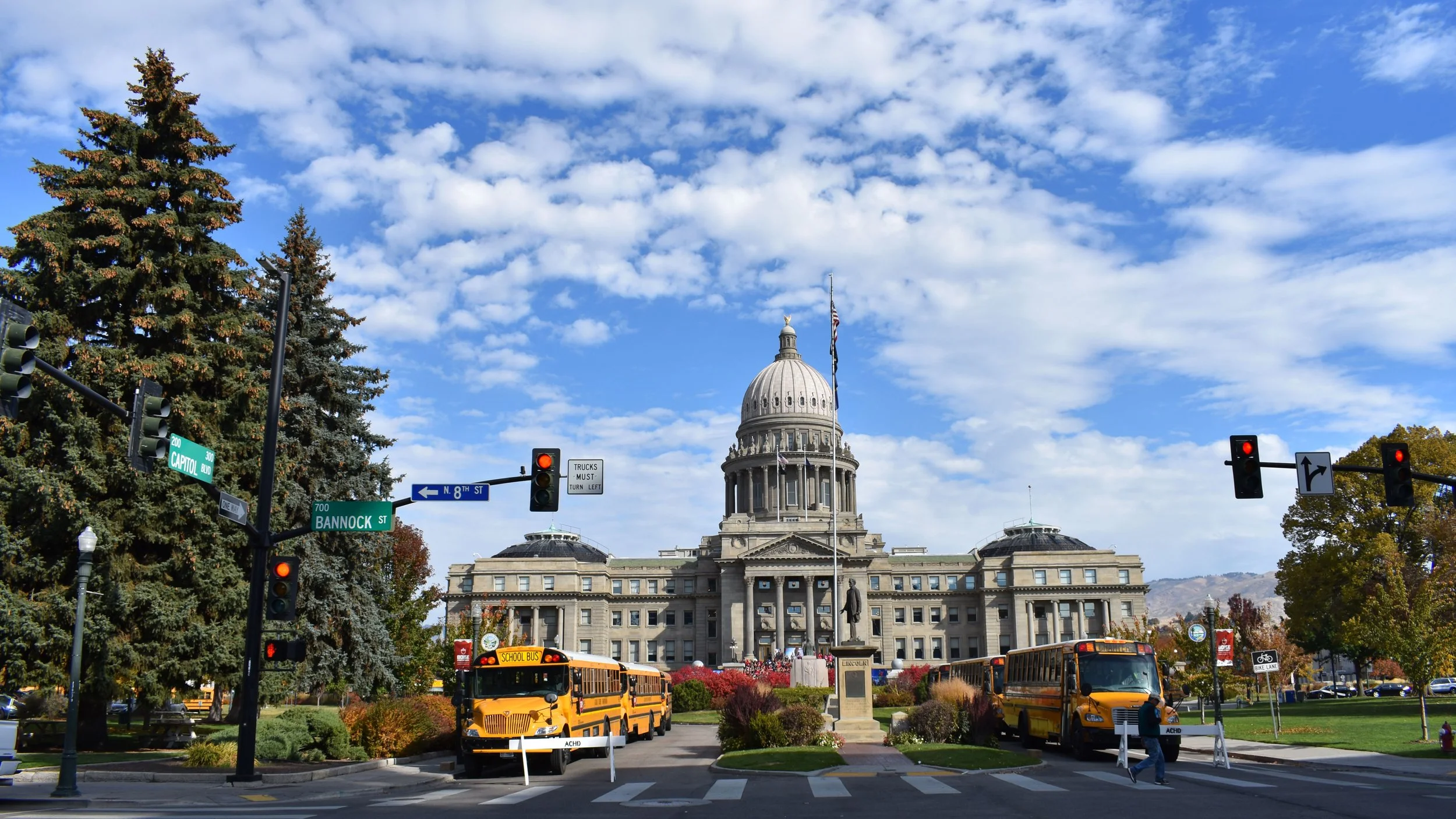
Top photo: Tamanoeconomico, Idaho State Capitol Building (Boise), Wikimedia Commons, CC BY-SA 4.0.
